This message was posted by a user wishing to remain anonymous
In reply to your question about the well-stirred model of hepatic metabolism ("why use f_u x C_out to drive the drug to be metabolized by enzymes, and the concentration after metabolism is the same as the original concentration?"), it is indeed counterintuitive that in this model the drug concentration after metabolism is the same as the drug concentration during metabolism. This is an artifact of the model's assumption of an infinite rate of mixing within the reaction chamber (the liver), which prevents the formation of a concentration gradient as would normally be expected. In the real world, mixing rates are never infinite and this idealized situation is not attainable; thus, the average internal reaction chamber concentration would be greater than C_out.
Consider the parallel tube model of hepatic metabolism, in which the mixing rate is zero. Here the average reactor concentration is C_ave = (C_in - C_out)/ln(C_in/C_out), which has a value between C_in and C_out. There is a corresponding but much more complicated C_ave expression for the more general dispersion model, which reduces to the parallel tube model for zero mixing and to the well-stirred model, C_ave = C_out, for infinite mixing. With the dispersion model, C_ave is always > C_out except in the limiting, idealized, case of infinite mixing.
Original Message:
Sent: 02-13-2025 17:27
From: Shu-Hao Hsu
Subject: What Are the Theoretical Insights Behind Defining the Driving Force Concentration in the Well-Stirred Model as fu × Cout Instead of fu × Cin?
Dear Responder,
Thank you for your insightful reply. Interestingly, when the driving force concentration of CL_int is defined as f_u x C_out, that is, when the enzyme is driven by the concentration of f_u x C_out to produce a certain metabolism rate, the concentration of the drug after being metabolized is still f_u x C_out. I am curious why use f_u x C_out to drive the drug to be metabolized by enzymes, and the concentration after metabolism is the same as the original concentration?
------------------------------
Shu-Hao Hsu
Ph. D. Student
University of Florida College of Pharmacy
Gainesville FL
[email protected]/[email protected]
Disclaimer: Opinions expressed are solely my own and do not express the views or opinions of my employer.
Original Message:
Sent: 01-28-2025 18:58
From: Anonymous Member
Subject: What Are the Theoretical Insights Behind Defining the Driving Force Concentration in the Well-Stirred Model as fu × Cout Instead of fu × Cin?
This message was posted by a user wishing to remain anonymous
In the well-stirred model, the liver is viewed as a reaction chamber containing a stirrer that operates at infinite speed. Because of the infinite rate of mixing, there is no possibility of a concentration gradient developing within the liver, and C_out must equal the conc. within the liver. By the principle of mass action, under the free drug hypothesis, the driving force within the liver must then be f_u x C_out.
Given that clearance is a rate of loss specified as a volume of specified conc. per unit time, and that systemic conc., which closely corresponds to C_in, is the conc. most readily available, CL is most conveniently expressed in terms of C_systemic ≈ C_in. At steady state, C_in is also a constant unaffected by rate of metabolism. Because total blood C_in, unlike f_u x C_in, constrains hepatic CL in cases of very rapid metabolism, it is both convenient and useful to base hepatic CL values on blood C_in. The "driving force" concept is most appropriately linked to a mass-action expression for a reaction rate, rather than to a clearance expression.
Original Message:
Sent: 01-27-2025 12:21
From: Shu-Hao Hsu
Subject: What Are the Theoretical Insights Behind Defining the Driving Force Concentration in the Well-Stirred Model as fu × Cout Instead of fu × Cin?
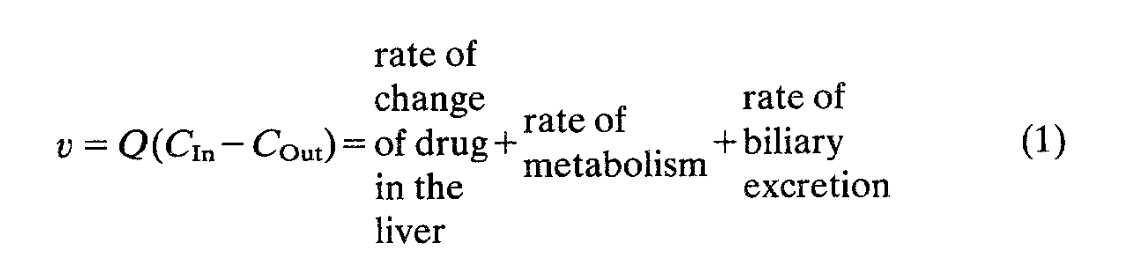
In recent decades, hepatic metabolism models have been predominantly based on the framework established by Dr. Rowland in 1977 (Journal of Pharmacokinetics and Biopharmaceutics), as illustrated in Equation 1. Regarding biliary excretion, the blood flow exiting the liver is marginally lower than the inflow, with the difference-attributable to bile flow-being less than 0.2% and often considered negligible in clearance calculations. At steady state, the net rate of change in hepatic drug concentration is zero, and the velocity of drug transferred from the bloodstream into the liver (v) equals the rate of metabolism (Vm), leading to the classical definition of hepatic clearance as shown in Equation 2.

In 2017, Dr. Benet (Clinical Pharmacology and Therapeutics) introduced the concept of a "driving force concentration," proposing that the hepatic metabolic rate is governed by a specific drug concentration, and hepatic clearance can be described as the metabolic rate divided by this driving force concentration. Within the well-stirred model (WSM), under the assumption of passive diffusion, the concentrations of unbound drug in venous blood (Cout,u) and within the liver (CL,u) are considered equivalent. As a result, Vm can be expressed as the product of intrinsic clearance (CLint), the unbound fraction (fu), and the concentration of drug exiting the liver (Cout), leading to the derivation of Equation 3.
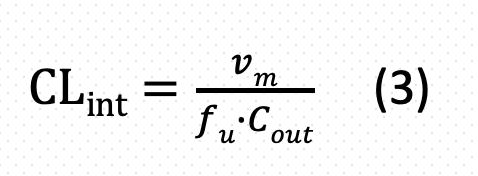
Building upon the models stated by Dr. Rowland (1977) and the driving force concentration concept by Dr. Benet (2017), I inferred that the driving force concentration for CLint is described as the product of fu and Cout. However, if CLint represents the intrinsic enzymatic metabolic capacity, it seems plausible to hypothesize that the driving concentration of CLint should instead be fu multiplied by the concentration of drug entering the liver (Cin), which is as same as the driving force concentration of hepatic clearance. Despite this, the WSM conventionally defines it as fu ×Cout.
Could you provide references or theoretical insights clarifying why the driving force concentration in the WSM is specifically defined as fu ×Cout rather than fu×Cin?
Reference:
- Pang, K.S., Rowland, M. Hepatic clearance of drugs. I. Theoretical considerations of a "well-stirred" model and a "parallel tube" model. Influence of hepatic blood flow, plasma and blood cell binding, and the hepatocellular enzymatic activity on hepatic drug clearance. Journal of Pharmacokinetics and Biopharmaceutics 5, 625–653 (1977). https://doi.org/10.1007/BF01059688
- Benet, L., Liu, S. and Wolfe, A. (2018), The Universally Unrecognized Assumption in Predicting Drug Clearance and Organ Extraction Ratio. Clin. Pharmacol. Ther., 103: 521-525. https://doi.org/10.1002/cpt.802
------------------------------
Shu-Hao Hsu
Ph. D. Student
University of Florida College of Pharmacy
Gainesville FL
[email protected]
Disclaimer: Opinions expressed are solely my own and do not express the views or opinions of my employer.
------------------------------