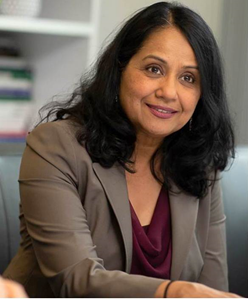
Meena Subramanyam, PhD
Vice President, Oncology
TAKEDA PHARMACEUTICALS
Email:
[email protected]
Dr. Meena Subramanyam is a biopharmaceutical executive with extensive expertise in therapeutic drug and companion diagnostics development. She has broad experience in implementing streamlined strategies to transition candidate therapies from discovery through clinical development for regulatory approval and commercialization in several therapeutic areas. As Vice President in the Oncology therapeutic area at Takeda Pharmaceutical Company, she serves as the Global Program Leader for the ALK inhibitor, Alunbrig™ and TAK-280, a bi-specific T cell engager molecule, and as the platform lead for the COBRA (conditional bi-specific T cell engager) platform. Prior to joining Takeda, Meena spent 19 years at Biogen in Cambridge, Massachusetts. As Vice President and Head of the Translational Sciences and Technology group she held broad responsibilities for developing and implementing biomarker, bioanalytical and diagnostic strategies for products in clinical development for neurodegenerative and autoimmune disorders and contributed to several successful BLA and NDA filings. Meena is a board observer at Portal Instruments, and a board member and past-President of WEST, a not-for-profit organization focused on the development of women leaders in science and technology. Meena is a recipient of the AAPS Global Leader Award, and the Luminary Award for leadership and mentorship from the Healthcare Business Women's Association. Meena holds a Ph.D. in Microbiology from Miami University in Ohio, USA.
What was the biggest challenge that you faced in your career? How did you overcome that?
One of the challenges I faced in my career as the head of a technical scientific function in R&D, was to establish and continuously reiterate the value and importance of the scientific contributions of the team, to support and advance the pipeline. Enhancing the profile and visibility of the group became important not only to secure resources to meet the organizational goals, but also to create meaningful opportunities to advance the career of my group members. I realized that the optimal way to manage this was to build mutually beneficial and influential alliances with my peers in R&D. Over time I forged strategic relationships with many functional leaders in R&D and set up regular 1:1 meeting with them to discuss topics of mutual interest such as strategies to deliver on goals, opportunities for collaboration on innovative ideas, as well as talent development. These business partnerships proved to be very successful and helpful to accomplish the primary mission and the leadership network established then remains active and strong even today.
Do you have experience receiving mentoring? If you do, what is the best advice that you have received from a mentor?
I have had the privilege of receiving advice and guidance from several outstanding mentors over the years. Two pieces of advice that I adopted whole heartedly is to feel comfortable and confident in my shoes and having the strength and conviction to decline career opportunities that did not excite me or motivate me, even if it offered the potential of significant upward mobility in the career ladder.
When you look back at your career, would you have done anything differently?
Being kinder to myself, giving me more of the benefit of the doubt, even though this feeling of "needing to know more" did serve as fuel to motivate me to work harder, be smarter and become a life-long learner!
Can you share two tips for early career professionals on how to develop their career successfully?
Cultivate the skill of active listening. This does not mean talking less! It means to build the habit of engaging people in conversation by remaining interested and curious in what they have to say and learning as part of that process.
Build your self-confidence and be vulnerable to admit when you do not know something. This will not only build trust with your colleagues but will likely help you identify your blind spots and learn new things.
What message would you like to give the women in Pharm. Sci field? What do you feel is the best way women can help each other in this field?
Build relationships that are long lasting based on common interests and form a network of trusted advisors whom you can share ideas and thoughts with. Also, support each other not only through collaboration, but also by amplifying accomplishments.
------------------------------
Pankajini Mallick PhD
Principal Scientist, Preclinical Pharmacokinetics | DMPK
San Diego CA
Disclaimer: Opinions expressed are solely my own and do not express the views or opinions of my employer.
------------------------------