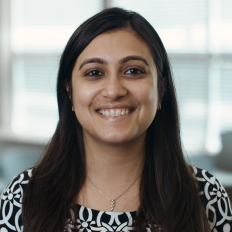
Charvi Nanavati, PhD
Associate Director
Clinical Pharmacology
Pfizer
10555 Science Center Dr, San Diego, CA 92121
O: (858) 622-6079 M: (619) 372-7507
Email: [email protected]
Charvi Nanavati is currently Associate Director, Clinical Pharmacology at Pfizer where she leads the clinical pharmacology strategy and model-informed drug development approaches for oncology programs. Her breadth of experience spans big pharma to medium as well as small biotech companies. Previously, she was at Ionis Pharmaceuticals where she was a Clinical Pharmacology and Pharmacometrics Lead for RNA-based therapies across cardiovascular, oncology and rare diseases. She also worked at Halozyme Therapeutics where she led the development and implementation of mechanism-based modeling and simulation for characterizing the subcutaneous delivery of monoclonal antibodies and different combination therapies in oncology. She was a member of the first leadership team of the AAPS Women in Pharmaceutical Sciences Community (WIPS) and has served as its Vice-Chair, Chair, and Past-Chair. Under her leadership, the WIPS community started a WIPS student sub-committee as well as initiated the "Ask a Woman Scientist" Series in the AAPS Newsmagazine fostering student and early career scientist engagement and mentorship across the organization. She has also served on the AAPS Annual Meeting Programming and Abstract Screening Committees over the years and currently serves on the AAPS Student Program Support Committee. She has mentored several graduate and undergraduate students for their academic research projects and industry internships and continues to do so at Pfizer as well. She received her Bachelor in Pharmaceutical Sciences from the Institute of Chemical Technology, Mumbai, India and her Masters and PhD. in Pharmaceutical Sciences from the University at Buffalo, State University of New York with an emphasis on PK/PD and Systems Pharmacology.
What was the most significant hurdle you encountered during your professional journey? How did you successfully navigate and overcome it?
One of the biggest challenges that I have faced in my career – is that the work that I do and what I bring to the table, in many instances, has not been valued at the right time! When you work in a field like Clinical Pharmacology and Modeling and Simulation which transcends across a lot of different functional lines, getting the alignment on obtaining and using the data, making predictions, and recommending the dose or a clinical strategy can be challenging. One can come across as being too pushy (especially being a woman) when you are just standing behind your data and model. I overcame that by being persistent, having informal conversations with team members about my work, presenting examples from literature, never getting personal and celebrating small wins. I focused on getting results on smaller projects that built the confidence within the team to trust me with a broader strategy.
Have you benefited from mentorship in your career? If so, what valuable advice have you received from your mentors?
I have not had experience in a formal mentorship program, but I have been fortunate to work with some amazingly kind and experienced people over the years that have shared their wisdom with me and to whom I go when I stall. One of the best pieces of advice that I have received is "Do not try to do too much. Focus on a few things and give your best". I think it is very meaningful. One can fall into doing so many things that it can dilute one's impact. It is important to focus on a few things and do them well. Impact builds over time.
Reflecting on your career thus far, are there any decisions or actions you would have approached differently?
No, not at all! I consider every step taken as an opportunity to grow and learn. Sometimes the decisions you take are professionally favorable, sometimes not, but there is always growth- you grow as a person, the technical and life experiences that you gain are invaluable (and nobody can take that away from you) and it eventually sets you up to be exactly where you need to be. My career path has been non-traditional – I went from joining a small biotech to a mid-size biotech and now to a large pharmaceutical company (you typically see the reverse sequence!), but that does not mean anything more or less! It is just different and that is what makes it all the more valuable and unique!
Can you share two valuable tips for early-career professionals seeking to advance their careers successfully?
The first tip is: Explore Options!! Go out, talk to people, and learn about different paths, even alternative paths. Everything is intertwined these days – health and tech, business, and science! There might be more out there that piques your interest and matches your skillset. Do not always take the path previous students in your lab have taken or your previous manager has taken.
The second tip is: Re-evaluate your career every 3-4 years- and ask yourself hard questions: Do you enjoy what you do or are you just too comfortable? Have you achieved the goals that you set in the first place when you started the job/work/project? Are you challenging yourself enough? How is work-life harmony? Are you thriving or surviving? See where the answers land and hopefully that will guide you to the next step of your career.
What message would you like to convey to women in the field of PharmSci field? How do you believe women can best support each other in this industry?
The number of women in the Pharm Sci field is growing, and I am so glad about that. However, as we move up the career trajectory, there is still gender inequity at the executive level.
My message is that we continue to do what we are doing, but also think about the next level. What can each one of us who is already in the field do to advance women and take them to the next level? Communities like the AAPS Women in Pharma Sci are a great start and a great platform to get these conversations going. There is an obvious challenge to manage work, family, and kids – but what can we do to support this harmony? Micro-steps like not scheduling key meetings at school drop and pick-up times can go a long way in establishing sustained women engagement. Given the global nature of the work, that might not always be possible, but, then there are other ways- advocate for other support programs at the workplace – subsidized child-care, better maternity leave, forming a women's resource group and most of all give a shout-out to your women colleagues -when they are in the room, but, especially when they are not in the room!
What does it mean to be a woman in science in your country?
Scientist as a first career choice is still limited in many countries (I guess most countries?!) including India where I am from and here in the US, where I currently reside, especially for women. I think a lot of it comes from a lack of awareness of the career path and its' potential impact on health and medicine. On the other hand, with increasing global health challenges and climate change, there are more people taking scientists seriously! Hence, in everyday life, being a woman in science oscillates from being inspirational to others to being ignored and dismissed! Coupled with this, the onus is still on women to take care of the family first, so being in science or being a scientist is not considered the main part of your identity. However, I hope I am changing that in my small way, and we collectively are as well!
------------------------------
Pankajini Mallick PhD
Principal Scientist, Preclinical Pharmacokinetics | DMPK
San Diego CA
Disclaimer: Opinions expressed are solely my own and do not express the views or opinions of my employer.
------------------------------